“Science works with chunks and bits and pieces of things with the continuity presumed, and [the artist] works only with the continuities of things with the chunks and bits and pieces presumed.”
— Robert Pirsig, Zen and the Art of Motorcycle Maintenance
Author: jkordy
The Voyeurs
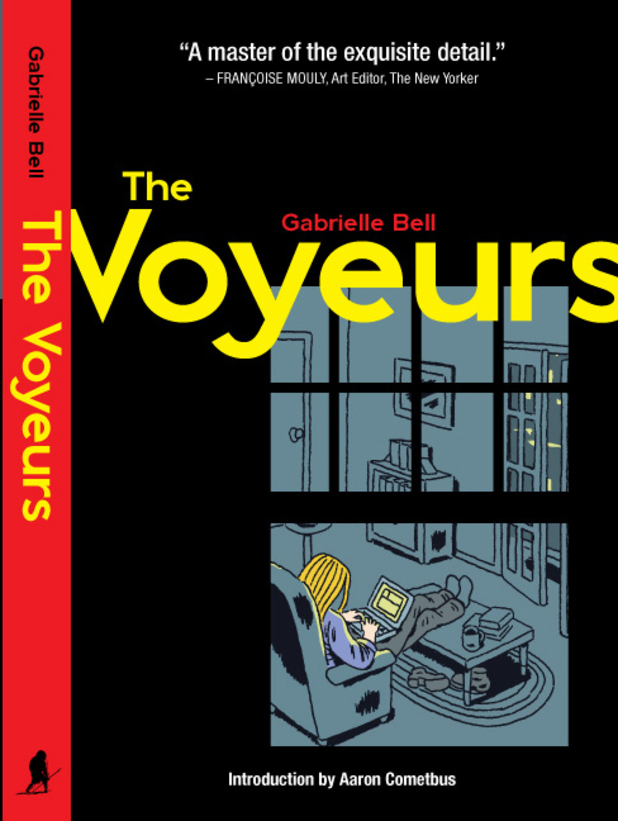
I’m very picky about my graphic novels*. Drawing style is most important for me. I usually flip through and soley based on the look of the panels make a decision. Probably not the best way to choose reading materials but that’s the way it is for me when it comes to this genre. I wasn’t familiar with Gabrielle Bell’s work before, and The Voyeurs almost made it to the discard pile. But I pressed on, I was thoroughly intrigued based soley on the first story, which at first I assumed is what the whole book was named after.
I am glad I pressed on, as Bell’s stories are thoroughly engaging, heartfelt and raw. She gives a really great look into the life of a creative person, the life of someone who lives in new york, the life of someone brushing against personal fame and success, and the life of someone struggling with the daily minutia of life. These are all one and and the same for her, and she has no qualms about laying out her insecurities and personal quirks for our inspection and perusal.
For example, she has an extreme ability to stay indoors and away from people, likewise she has an extreme ability to distance herself from those around her, no matter the situation.
In the end we are the voyeurs encroaching on Bell’s life and all of her personal moments and inner thoughts full of self-doubt, introspection, and awkwardness.
* Incidentally I learned form this book that among writers (drawerers? j/k) of this genre, Comics may be the preffered term, as “graphic novel” sounds too much like marketing speak and they really see themselves as comic artists. I always thought graphic novels distinguishes it from the likes of marvel comics and other such things I would like to distance myself from, when I mention to people one of my favorite genres, but perhaps I’m just pretentious. I still feel it is an important distinction but I’m open to discussion.
Nature of Technology
I was really surprised to find I never posted a review of this book. I finished it a while ago, and it really is quite fascinating. I keep thinking of it, especially whenever the question comes up of how technology evolves and changes over time. I wanted to look up my thoughts on it but alas, no posts.
I really recommend this book to any technologists out there. The subtitle of this book is “What it is and how it evolves” and W. Brian Arthur really tries to answer that question. But for me the word Nature in the title is the key, in this book. W. Brian Arthur applies somewhat of a biologists view to all of the technology around us and puts forth a thesis for how the evolution of technology works.
There are some stumbles a long the way, a lot of the book is very repetitive, and because he has a very specific thesis of how it all works he does a lot finagling of facts and ideas and examples to fit into a nice tidy package. For example the distinction between science and technology, and how scientific explanations/theories are cousins to technology but not actually technology. On the other hand, his explanation of how sometimes new technology can arise without scientists first deeply thinking about it, just by combining existing solutions is an exciting and novel idea.
His basic thesis is that technology evolves when a new novel combination becomes commonplace and stable enough to become a component in a new higher up more complex and abstracted solution. And on and on it goes. Makes sense. Once in a while an entirely new component becomes available, that is based on a new understanding of the universe and on harnessing and or exploiting new previously undiscovered phenomena. In time, as they become miniaturized and super stable, these too just become cogs in the progression.
I often think about this in terms of the web, of how each layer of abstraction still exposes all the layers underneath. jQuery is a nice framework, a great abstraction that lets you get things done quickly, but there is nothing stopping you from tweaking the underlying javascript. You can always tweak the php, or your data calls, circumvent any framework you use. The whole web is still the basic elements, css, html js. This is great for ad hoc solutions and infinite customization but in terms of super fast paced evolution, it hinders us, because we never get to the level of interchangeable components that can evolve in the way that W. Brian Arthur proposes.
Quote
“Anyone who says you can’t see a thought simply doesn’t know art.”
— W. Ann Reynolds
Martin Creed @ the MCA

The MCA performance, which I had assumed was commissioned by the MCA, but I have come to find out is actually a pre-existing work, perhaps I should read more before these things, but I like to be surprised, can probably be summarized by one of the songs performed within it, entitled “What’s the point?”
But just like that song, though you may ponder that very question during some the songs and even during parts of the whole performance, if you stop there, then indeed what is the point? But if you dig deeper, I think there is much to enjoy here. And indeed the evening featured one of my favorite movement phrases I have ever seen.
The rest is a little on the banal side, but in all earnestness, I’m pretty sure banality is part of the point indeed. The basis of this performance is ballet’s five basic positions. Martin pairs each one with one note, and we go form there.
As martin points out, only two of the positions allow you to move sideways, and three of them sort of allow front/back movement. Hmm how do you make a performance out of that? We soon find out. Not to mention cacti, some awesome noise making bandmates, and some very amusing live edited/mixed nsfw background videos. Well only two of them were nsfw, the rest featured things like the alphabet. or the numbers 1 to 100.
I’m sure Martin was more interested in simplicity, than banality, but the line is so thin. Not sure it matters, both can get you into a trance like state. If you let the simplicity wash over you, if you appreciate the humor of it, and the dancers and musicians earnest performance of it, then you really can get something from it.
Nov 15–16, 2012
museum of contemporary art
chicago
museum of contemporary art
chicago
You may have seen the giant rotating “mothers” outside the MCA Chicago, here’s a great little interview with Creed about that piece, but also a great little window into the mind that is Martin Creed:
this page is so info-shallow, I just had to link to it:
http://dance.about.com/od/stepsandmoves/ss/Ballet_Five.htm
Holy Motors – Leos Carax

Wow. You may think you have some ideas about what the movie is about based on the above image. But you have no idea. Starting with the fact that the above scene is only a minute or two of the whole thing, is towards the end of it all, and is followed by all of the limo’s you see above, talking to each other and discussing their days and their drivers.
I thought I was fan of Leos Carax, but this film may have stretched me to the limits. Not subject matter wise, not even lack of narrative wise, but really the super slow pacing made it very hard for me to follow. I think my wife was right in saying this is the kind of movie David Lynch put’s on to relax. When he wants to watch something weird, this is it. Lynch films are straightforward compared to this.
Still I can’t fault a film that has one of my favorite characters of all time, the reprise of Tokyo!‘s M. Merde. Though I feel this incarnation, by adding to the backstory, and offering perhaps a slightly different take on the Merde’s history, takes away a bit from the shear irreverence of that character as a whole.
In any case, Senior Merde is only one of the ten or so characters Denis Levant takes on. I am also a fan of his, and continue to be. He does a tremendous job portraying all of the characters in this film and he really dives into each role (on both levels, you’ll see what I mean).
In the end I really appreciate this film. There just isn’t enough weirdness in this world. Not enough risk taking. Not enough just exploring and following your imagination into some weird sh!t. On that front, this film delivers, and I appreciate that. Oh and did I mention Kylie Minogue and Eva Mendes also star? go figure.
more info at
http://www.telegraph.co.uk/culture/film/filmreviews/9571362/Holy-Motors-review.html
IMG 00308

That’s easy!
That’s so easy! Anybody could do that. I could do that in my sleep! Oh really? Have you? I know it looks easy, everything looks easy. The harder it was to pull off the more work was put into it to make it look obvious and easy, the more they all point and say – that’s easy, I could do that.
Well the devil, or good product, or a truly magnificent finished piece of work is in the details. And those ain’t easy. Well sure, in theory it’s easy. “Oh that, that’s just that with that and you’re done.” Or, “is that all?” Or “that’s just that, but less of it, more minimal. Seriously, anyone, could, do that. I had that idea a long time ago. I could have done it anytime, I just never got around to it.” Well ‘in theory’ everything is easy. That’s why it’s theory and not practice. In real life you have to deal with all the crap that you just gloss over, and not think about, while you’re too busy thinking about how it’s all so easy.
That’s just it. Nothing is easy. Some things may look easy, if you’ve got enough skills and experience, you’ll make it look easy. but it ain’t. Not in the real world at least. It all gets complicated real fast, and real solutions take work. Untangling that ball of wires, to make a straight wire, takes real work and skill.
Hey you, instead of going around pointing out how easy everything is, which you are too ignorant to know better, go out and do something, make something yourself. Prove to me how easy it all is.
And you, the one looking back on your own work, appreciate what you done, getting them to say “That’s easy!,” took real hard work, appreciate and remember that.
Urbanized

Really enjoyed this little nugget. A great short documentary about all the smart ways that cities are dealing with the reality of exponential city growth. 75% of the world’s population will live in urban centers by 2050. As the world’s population grows cities grow even faster. As many clips in the film show, it’s not very wise to not plan for that, since you can’t really stop the growth. That’s where Urban design comes to the rescue!
And that is what this film is really about. It’s the third in a trilogy of films Gary Hustwit has made that focus on design, alongside the just as great Helvetica and Objectified films.
In this one, he covers many of the great solutions some of the worlds biggest urban centers have come up with or are planning to implement or are just plain struggling with. He also covers some urban design mis-steps, and how urban designers and planners have learned a lot from them. Overall, a lot of great interviews, views, and ideas in a great little package. Highly recommend.
Read some more about the film at
fastcodesign.com
Quote
“a film costs at least $100,000 per minute, and after 180 minutes, the human eyeball is in danger of melting” – David Mitchell